Short answer
OSHA rules protect the workers doing biohazard decontamination, not the property itself. The Bloodborne Pathogens Standard is the core rule for blood and other potentially infectious materials, supported by standards on respirators, personal protective equipment and chemical hazard communication. As a property owner, you benefit by asking a contractor to show its exposure control plan, training records and respirator program before work starts.
Does OSHA regulate my property or the people cleaning it?
OSHA regulates employers and the conditions their employees work under. It does not issue a certificate saying a room is clean, and it does not tell a homeowner or building manager how to restore a space. Its standards describe what an employer must do to protect workers who could contact blood, body fluids, sewage, chemical disinfectants or contaminated sharps.
That distinction matters when you hire a decontamination company. A firm that follows OSHA closely is a firm that has thought through hazards in writing, trained its people and planned how contaminated gear leaves your building. Those same habits tend to produce cleaner handoffs, better documentation and fewer surprises for you.
If you are a business owner whose own staff might be asked to clean a spill, OSHA may apply to you directly. In that case the question is not only whom to hire, but whether your employees have been trained and equipped for the exposure you are asking them to take on.
The OSHA standards that come up most
Several federal standards tend to appear together on a decontamination job. Each covers a different part of the risk, and a competent contractor should be able to explain how they apply to your specific site rather than reciting a list.
- Bloodborne Pathogens, 29 CFR 1910.1030: exposure control plans, engineering and work-practice controls, protective equipment, hepatitis B vaccination offers, labeling, training and recordkeeping for work with blood or other potentially infectious materials.
- Personal Protective Equipment, 29 CFR 1910.132: a written hazard assessment that justifies the gloves, suits, eye and face protection chosen for the task.
- Respiratory Protection, 29 CFR 1910.134: a written program, medical evaluation and fit testing whenever respirators are required.
- Hazard Communication, 29 CFR 1910.1200: safety data sheets, labels and training for the disinfectants and cleaning chemicals used on site.
- The General Duty Clause of the OSH Act: a catch-all obligation to protect workers from recognized serious hazards that no specific standard addresses.
What does the Bloodborne Pathogens Standard actually require?
The Bloodborne Pathogens Standard is the backbone of this field because so much decontamination work involves blood or fluids that may carry hepatitis B, hepatitis C or HIV. The employer must have a written exposure control plan that identifies which jobs involve exposure, how that exposure is reduced and what happens after an incident such as a needlestick.
Training is not a one-time event. OSHA's Bloodborne Pathogens Standard, as published by OSHA in 2001, requires bloodborne pathogen training at initial assignment and at least annually thereafter. The standard also sets retention periods: OSHA's 2001 standard says employers must keep bloodborne-pathogen medical records for the duration of employment plus 30 years, and training records for 3 years.
The standard also expects employers to offer the hepatitis B vaccine to exposed workers, to use leak-resistant labeled containers for regulated waste and to clean and decontaminate work surfaces with appropriate disinfectants. It describes universal precautions, meaning that all blood and body fluids are treated as if they were infectious.
For you, the practical takeaway is simple. Ask whether each technician coming to your property is covered by the company's exposure control plan and has current annual training. A contractor who hesitates on that question is telling you something important.
Respirator and PPE rules on your job
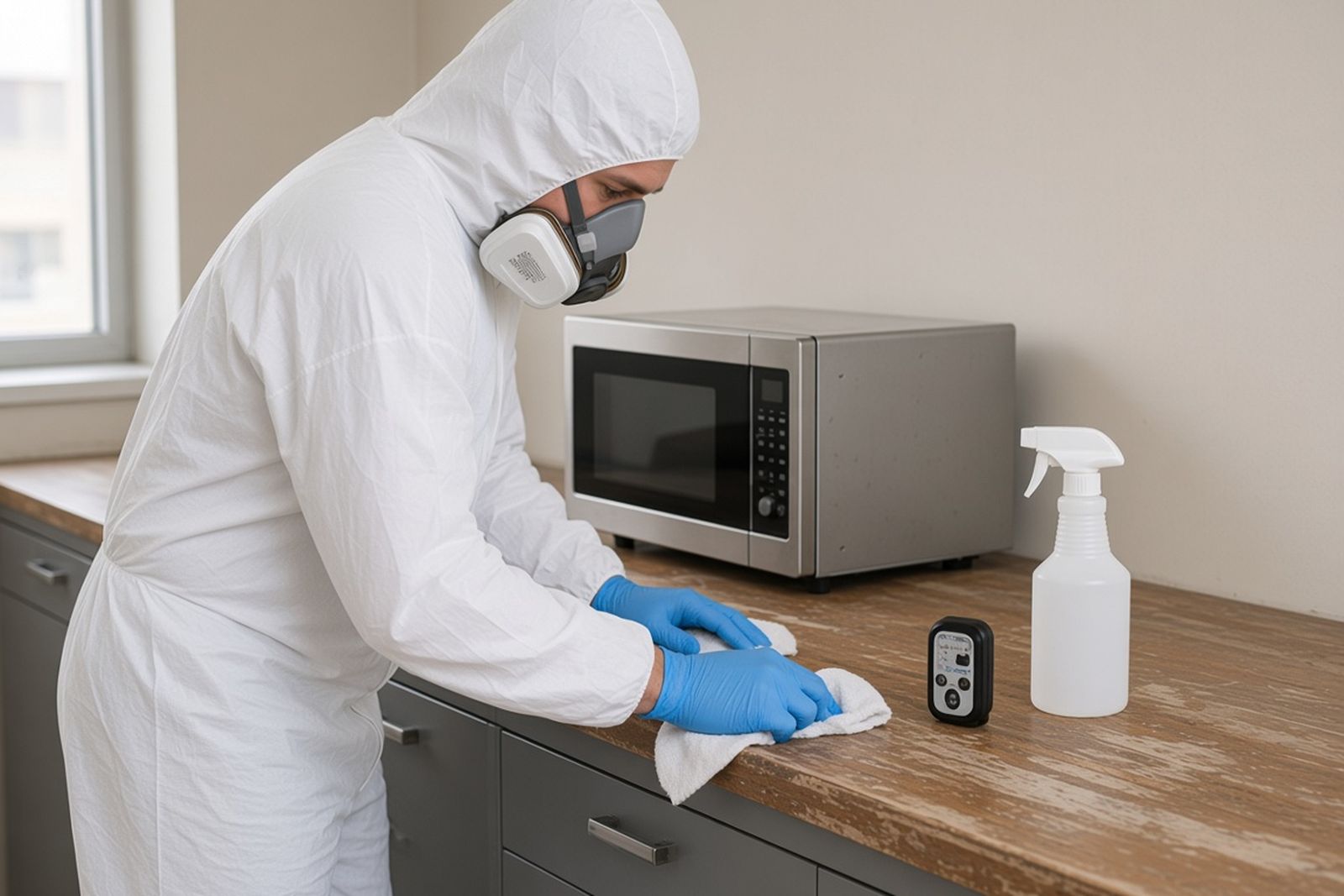
Crews do not choose protective gear by habit. Under the PPE standard, the employer is supposed to assess the hazards of the task and certify that assessment in writing. That is why two decontamination jobs in the same week may look very different: a small dried blood spot on tile calls for a different kit than a large fluid release soaked into subflooring with strong disinfectant fumes in a closed room.
When respirators are needed, the respiratory protection standard adds more steps. Workers must be medically cleared to wear a respirator, fit tested for the specific model and trained on its limits. A technician in a poorly fitted mask is not protected, no matter how serious the equipment looks.
Chemical exposure is part of this picture. Disinfectants strong enough to inactivate bloodborne pathogens can irritate lungs and skin. Good hazard communication and ventilation planning protect the crew and reduce lingering odors for the people who return to the space.
Paperwork a compliant company should be able to show you
You do not need to audit a contractor's full safety program, but a few documents tell you a lot. Ask to see them before signing, or ask that summaries be included in your job file. Many reputable firms will provide these without being asked.
- A current written exposure control plan and confirmation that it has been reviewed within the past year.
- Proof that assigned technicians completed bloodborne pathogen training within the past 12 months.
- A written respiratory protection program and fit-test records for anyone who will wear a respirator.
- Safety data sheets for every disinfectant and cleaning product planned for your property.
- A description of how contaminated PPE, sharps and debris will be packaged and removed.
- Proof of workers' compensation and liability coverage, so an injury on your property is not your financial problem.
Illustration: when an employer's own staff face the spill
Consider a small fitness center, described here only as an illustration. Staff arrive in the morning to find that a member suffered a serious nosebleed overnight in a locker room, leaving blood on a bench, the tile floor and a stack of towels. The manager's first instinct is to hand a mop and bleach to the morning front-desk employee.
She pauses and asks whether that employee has bloodborne pathogen training, gloves rated for the task and a way to bag the towels as regulated waste. The honest answer is no. Because the business is the employer, asking an untrained worker to clean the spill could create an OSHA problem for the gym as well as a health risk for the employee.
The manager closes the locker room, calls a decontamination firm and asks for its training records and product list. The technician cleans and disinfects the bench and floor using an EPA-registered product with a bloodborne pathogen claim, bags the towels in labeled containers and leaves a short written summary. The sequence shows how OSHA rules can reach an ordinary business that never thought of itself as handling biohazards.
Do state OSHA plans or local rules change the picture?
Many states run their own OSHA-approved state plans. These plans must be at least as effective as federal OSHA, and some add requirements or interpret standards more strictly. If your property is in a state-plan state, the contractor's obligations may be broader than the federal text suggests.
Separate from worker safety, states and counties regulate how medical or biohazardous waste is packaged, transported and treated. Some local health departments also issue guidance for specific events, such as sewage releases or infectious disease cleanup in public facilities. None of these replace OSHA, and OSHA does not replace them.
Ask your contractor which state plan and waste program apply where you are, and check your state labor department's occupational safety pages if the answer is vague.
Before the crew arrives
Your role is to keep people out of the affected area, preserve information and make it easy for a compliant crew to work safely. A few steps help regardless of the size of the job.
- Close off the area and keep children, pets and untrained staff away from any blood, fluids or sharps.
- Do not start scrubbing or spraying disinfectant yourself if you lack gloves, eye protection and training; you can spread material and damage evidence of what surfaces were affected.
- Turn off fans or HVAC serving a closed room only if you can do so without entering the contaminated zone.
- Write down what happened, when, and which rooms or surfaces were involved.
- Ask the contractor for its exposure control plan, training dates and product list before work starts.
- Request a written completion summary that lists areas treated, products used and waste removed.
Why do OSHA rules matter even after the crew leaves?
A company that treats OSHA as a paperwork exercise is more likely to cut corners on containment, waste handling and verification. A company that treats it as a framework for doing the work carefully usually leaves you with a space that is clean, a clear record of what was done and no injured workers asking questions about your property later.
Keep the contractor's completion summary with your building or insurance records. If anyone later asks how the incident was handled, you will be able to show that trained workers followed a written plan. That record is often worth more than any verbal assurance given on the day of the job.