Knowledge check with explanations

Biohazard Decontamination quiz and study guide

Find out what you already understand, then read the parts you missed.

This quiz checks whether what you have learned about blood and body-fluid messes really fits together. It covers the questions people face in real life. How do you tell a hazard from a mess? When is an official release needed before work starts? How do you keep a small problem from spreading through a building? Why is disinfecting a separate step from cleaning? Where can soiled materials go? What paperwork will matter weeks later? No question asks you to memorize rules word for word. Each one asks you to reason the way a trained crew would. That is the same reasoning you need to judge whether a provider is doing the job well.

Get an email reply about biohazard decontamination

Send a short message to the follow-up inbox. A coordinator can reply by email. This form does not send emergency help; call 911 first if anyone is in danger.

Tell us what you need help with. Share a short description; please leave out medical details, access codes, and other sensitive information.

A request does not confirm a booking. For immediate danger, contact local emergency services.

Or email info@prompartybuses.com

Take the quiz before the study guide if you want an honest picture of where you stand. Take it after if you want to lock in what you learned. Each answer comes with a reason, and the reasons are the real value. A wrong answer with a clear reason is worth more than a lucky right one. Your score is not saved anywhere, and it does not certify anything. If a question surprises you, follow the linked guides to learn more. When you are ready to talk with a provider, the words from this quiz will help you ask sharp questions and spot answers that dodge them.

Biohazard Decontamination knowledge check

15 questions about real biohazard decontamination situations: staying safe, what happens, cost, choosing help and the rules. Every answer comes with a short explanation.

Why this quiz matters

Knowing these basics makes it easier to spot bad advice and ask a company the right questions. This quiz is educational — it does not certify anyone. After the quiz, review the explanations for questions you missed. For professional guidance on your specific situation, use the contact form at the top of the page for an email reply.

Progress1 / 15
SafetyQ1

A worker gets someone else's blood in their eye while helping after an injury. What should happen first?

Study guide: the six ideas behind the questions

Read these before or after the quiz. They cover the concepts every question draws on, written for biohazard decontamination specifically.

1Recognizing a biological hazard

A biological hazard is any material that can carry germs that cause disease. For a property, that usually means blood, fluids that may hold blood, human or animal waste, and things soiled by them. Spotting one starts with an honest look. What is there? How much? What did it soak into? Who might have touched it? Dried material is not safe just because it is dry. Some germs live on surfaces for a long time. Treat unknown liquids with the same care as known ones. Ask whether the mess sits on a sealed surface or has soaked into something soft. Ask whether needles or blades could be hidden nearby. Ask whether children or people with weak immune systems use the space. Those facts shape every later choice.

2Scene release and who holds authority

Before any cleanup starts, someone has to confirm the space is yours to clean. After an injury, death, or crime, the police or a medical examiner may need to finish first. Disturbing the scene before it is released can get in the way of an investigation. At work, the employer's written exposure plan names who decides. In a rental, the lease and the landlord's rules matter. In a school or clinic, an administrator or infection control lead usually decides. Rules vary by state and county, so check with the local authority when you are unsure. Write down who approved the work and when. That record answers questions from insurers and inspectors later.

3Containment and stopping the spread

Germs spread mainly on feet, hands, tools, moving air, and water. Containment means blocking those paths. Close the door. Keep people and pets out. Do not walk through the area to look at it again. Do not point fans toward the space. If the heating and cooling system serves that room, think about turning it off until a crew checks whether it spread anything. Do not carry soiled items to another room. Do not rinse anything down a sink or drain. Pros take this further with plastic walls, set entry points, protective clothing that stays inside the work zone, and air cleaners when fine particles may be present. Your job before they arrive is simply to freeze the scene.

4Cleaning versus disinfecting

Cleaning removes material from a surface with water, detergent, and scrubbing. Disinfecting uses a registered chemical to kill the germs left after cleaning. They are two steps with two goals, and doing only one leaves the job half done. A surface that looks spotless can still hold germs if nothing was used to kill them. A surface soaked in disinfectant while still dirty may shield germs under the grime. The product label sets the details. It says which germs it works on, how to dilute it, and how long it must stay wet. Random household products do not replace that care. Mixing chemicals for extra strength can make dangerous gases.

5Where contaminated waste can go

Once material comes off a surface, it has to go somewhere, and that path has rules. Items soaked with blood or other body fluids that can carry disease often fall under medical waste rules. So do used safety gear and sharps, such as needles and blades. Those rules can require labeled containers, licensed haulers, and treatment at permitted sites. Lightly soiled items that were disinfected may be allowed in normal trash in some places but not others. Sharps always need containers that needles cannot poke through. Rules vary by state and county, so check with the local authority or your state environmental agency instead of guessing. A provider should explain the path for each kind of waste and give you records showing where it went.

6Documentation and verification

Checking the work is how you learn the job is truly done, not just over. On hard surfaces, crews may use a quick swab test that shows leftover organic residue. It does not detect germs. They may also use protein swabs, along with a careful look in good light. For soft materials, checking usually means confirming that soaked items were removed. No one should pretend a wipe reached inside them. Records tie it all together. They include before and after photos, and a list of products with their EPA numbers and how long each stayed wet. They also include moisture readings where fluid spread, the waste shipping records, and a written note of what was cleaned and what was replaced. Keep that file. Insurers, buyers, employers, and regulators may ask for it. A spoken promise will not satisfy any of them.
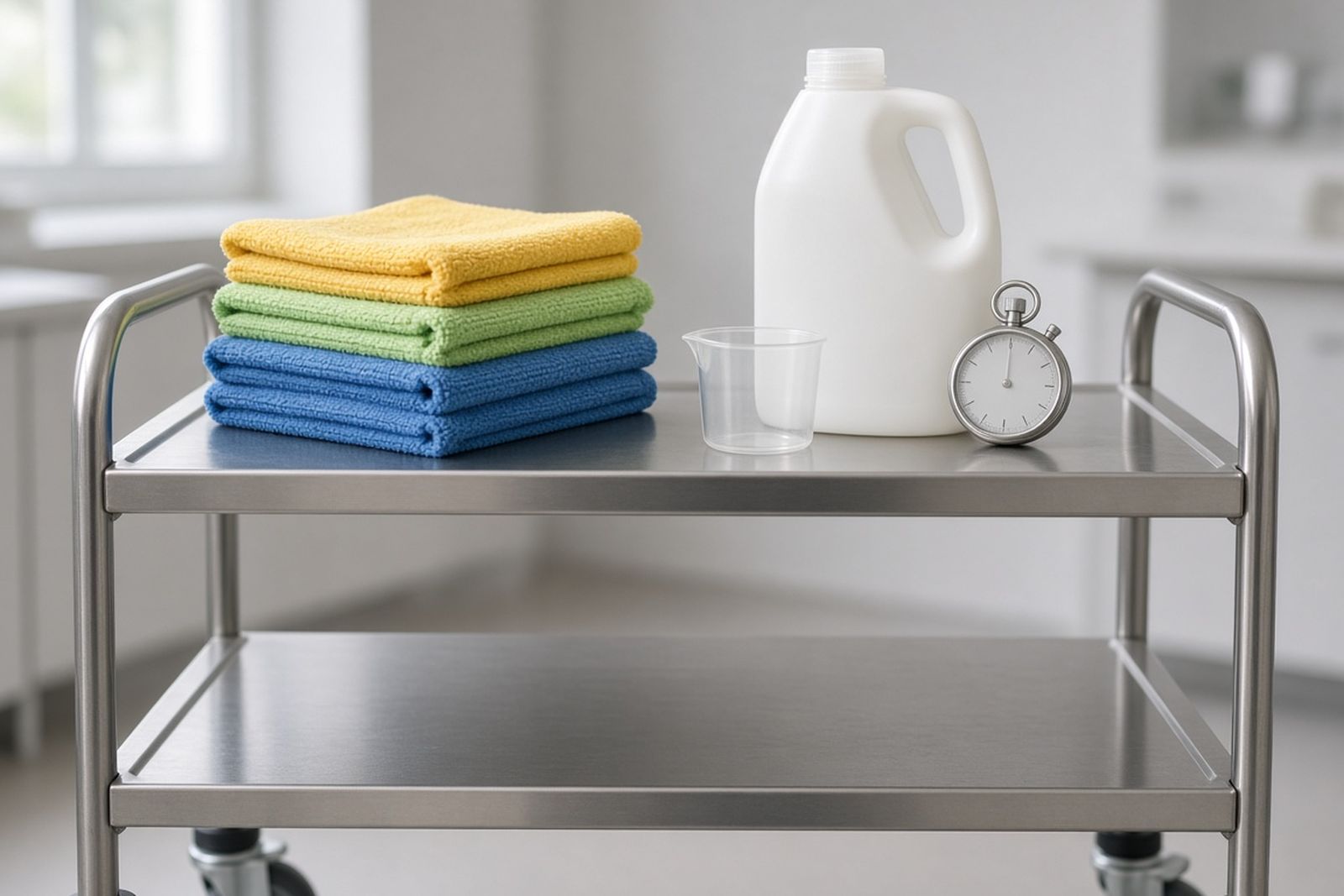
Color-coded microfiber cloths, a disinfectant jug, a measuring cup and a stopwatch on a steel cart
Illustrative photo, not a job record. Color-coded microfiber cloths, a disinfectant jug, a measuring cup and a stopwatch on a steel cart.

Biohazard Decontamination facts the quiz draws on

98.1%

Manual wiping met the study's disinfection-success criterion on 98.1% of surfaces versus 75.5% for UV-C.

Read with care: Specific device, protocol and success criterion; no patient infection endpoint.

Source: Knobling et al. (2023)Naturally contaminated surfaces in a comparative field test.

81%

81% reported bleach use on high-touch surfaces in contact-isolation rooms.

Read with care: 47 of 273 contacted participated; practices were reported rather than observed.

Source: Han et al. (2021)47 US hospital environmental-services respondents across 26 states; 2019 survey.

8

Products above pH 8 accounted for 74% of failures in the experiment.

Read with care: Accelerated test conditions; not a failure rate for installed equipment.

Source: Jennings et al. (2024)Eight wipe formulations tested on healthcare plastics under fixed strain for seven days.

87.6%

87.6% had heard of biofilms, but only 39.1% knew of dry-surface biofilms.

Read with care: Reported knowledge and practices, not observed compliance or infection outcomes.

Source: Centeleghe et al. (2024)137 healthcare-professional respondents; convenience/purposive online sample across the pandemic.

These figures are public research and agency data, not this network's own job records. Keep each number with its population, year and limits; none of them predicts cost, timing or outcome at a specific property.

Questions about the biohazard decontamination quiz

Is the quiz meant for professionals or for property owners?

It is written for owners, managers, and workers who need to make choices. Some pros also use it as a refresher. The questions focus on judgment, not technical steps. They cover spotting when a mess is beyond normal cleaning, knowing who must approve the work, and knowing what a good work plan and waste path look like. A trained crew's formal training goes much deeper than anything this quiz covers.

Does a high score mean I can handle a contamination myself?

No. Knowing the ideas is not the same as having the safety gear, registered products, waste containers, and training to use them safely. A strong score means you can spot a hazard, ask sharp questions, and judge a provider's plan. Whether you can handle a given event depends on its size, the surfaces involved, and who is at risk. The DIY risk check tool walks you through those factors.

Why do several questions ask about authority and release?

Because starting too early is one of the most common and serious mistakes. Cleaning before a scene is released can disrupt an investigation. Cleaning without the right person's approval at work or in a rental can lead to legal risk and fights over payment. The quiz stresses this because the physical steps of cleanup are easier to fix than a choice to act before you had permission.

Are the regulations referenced in the quiz the same everywhere?

Federal rules such as the OSHA blood safety standard apply widely to employers. But rules for handling, hauling, and disposing of waste vary by state and county. The quiz points to general ideas and tells you when to check with the local authority. If a question seems to clash with what a local official told you, follow the official advice for your area. Treat the quiz as a general reference.

What should I do if I miss the question about stopping the spread?

Read the containment section of the study guide. Then think about the space you are dealing with. Most errors come from gut reactions, such as opening windows, running fans, or carrying items out to look at them. All of those spread germs. The habit to build is simple. Stop, close off the area, and change nothing until someone with a plan arrives. That one habit prevents most of the mistakes the quiz targets.

Can I share my quiz results with a provider or insurer?

You can, but they will not carry weight in a claim or a hiring choice. The quiz does not produce a certificate. What providers and insurers care about is a record of the event itself. That means photos, dates, who approved the work, and the written work plan. Use the quiz to prepare yourself for those talks. Do not use it as proof in them.

How often is the quiz updated?

We review questions when advice from agencies such as OSHA, the CDC, or the EPA changes in ways that affect property choices. We also review them when readers tell us a question is confusing or out of date. Product lists and waste rules shift over time, so the quiz sticks to lasting ideas. Always confirm current rules with the right authority before you act on any specific detail.

What other visitors think

Poll results

Every count is a real visitor vote; nothing is seeded or padded. One vote per poll per device, and you can change your answer.

Your experience

When you found a biohazard mess, what was your first instinct?

No visitor votes yet
Safety

What would most likely make you hire a provider instead of cleaning up yourself?

No visitor votes yet