Short answer
Before hiring a biohazard decontamination company, ask how its workers are trained under the OSHA bloodborne pathogens standard, which disinfectants it uses and why, how it decides what to remove, how regulated waste leaves your property, what verification and records you will receive, what insurance it carries, how it prices changes, and who will actually do the work. Clear, specific answers matter more than slogans.
Why should you ask questions when you just want the mess gone?
When you are dealing with blood, bodily fluids or sewage in your home or workplace, the natural instinct is to hire the first company that answers the phone. That urge is understandable. Still, a few minutes of questions can separate a provider who follows a careful, documented process from one who sprays a deodorizer and leaves.
The questions below are designed for biohazard decontamination specifically. They focus on the things that determine whether pathogens are actually addressed, whether your property is protected from unnecessary damage and whether you will have records if an insurer, landlord or employer asks later.
You do not need to ask every question on the first call. Start with the ones that matter most to your situation, and save the rest for the on-site visit.
It can help to have a notepad ready, or to ask a friend to make the calls for you if the event involved someone you love. Write down each company's name, the person you spoke with and their answers. When you are tired and upset, a written comparison is far easier to trust than memory, and it gives you something concrete to review before you sign.
Questions 1 and 2: Training, and who will actually be on site
Ask what training the crew receives, how often it is refreshed and when each technician last completed it. A provider that works with blood and other potentially infectious materials should be able to describe its program without hesitation.
Ask whether employees are offered hepatitis B vaccination, how the company handles an exposure incident and whether it maintains a written exposure control plan. You are not auditing their compliance; you are listening for whether they understand the framework.
Then ask who will actually do the work. Some companies subcontract jobs to other crews. That is not automatically a problem, but you should know the name of the company entering your property and whether its training meets the same standard.
Questions 3 and 4: Disinfectants and how they are applied
A careful provider can name the products they plan to use and explain why. Ask for the EPA registration number and whether the label supports the organisms and surfaces involved.
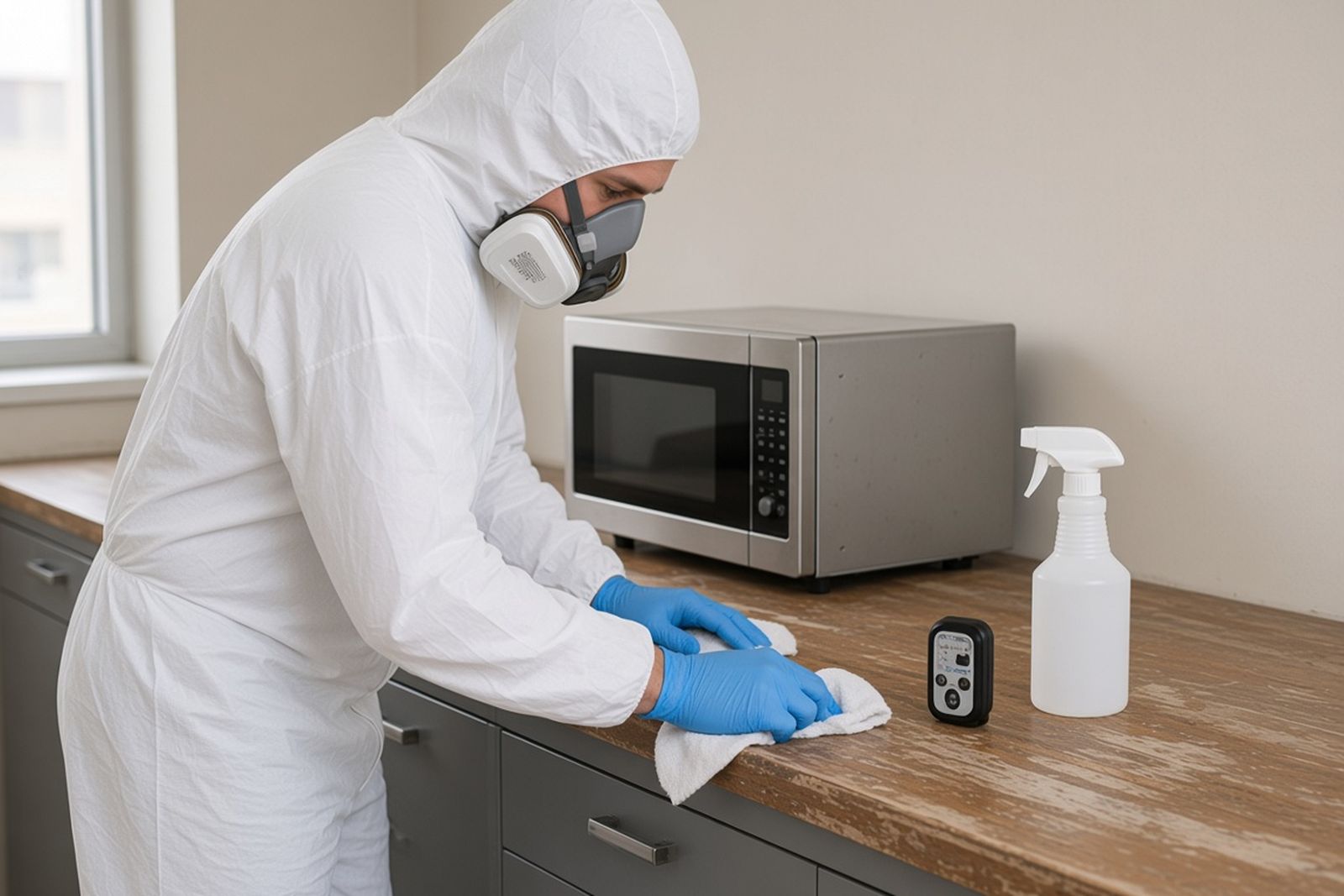
Follow up by asking how they will meet the label's contact time. Listen for a description of cleaning first, then applying disinfectant and keeping the surface wet for the full period. If the answer is a quick spray or a fogging treatment with no mention of cleaning, keep looking.
It is also fair to ask whether the chosen products are compatible with your surfaces. Some disinfectants can damage stone, certain plastics, finished wood or electronics. A provider who considers material compatibility is less likely to cause avoidable damage.
Question 5: How will you decide what to remove and what to save?
Porous materials, such as carpet, pad, drywall, upholstered furniture and mattresses, often absorb fluid in ways that disinfectant cannot reach. Removal is sometimes necessary, but it should not be automatic.
Ask how the provider will determine the extent of contamination. Do they use moisture meters, lift carpet edges, inspect under baseboards and check subfloor? Will they talk with you before removing items, especially those with sentimental or high financial value?
A thoughtful answer might sound like this: they will map where fluid traveled, save what can be reliably decontaminated, remove what cannot, and explain each decision in writing. That approach protects both your health and your budget.
If personal items are involved, ask how the company handles them. Photographs, documents, jewelry and keepsakes found in an affected area deserve careful treatment. Some providers can clean hard items and return them sealed, while others set them aside for you to decide on. Knowing their practice in advance avoids painful surprises.
Questions 6 and 7: Waste removal and the records you receive
Regulated biohazard waste has to be packaged, transported and disposed of according to state and local rules. Ask whether the company transports the waste itself or uses a licensed hauler, and what documentation you will receive. If you want to check the answer, the state environmental or health agency that runs the medical waste program can tell you what applies at your address.
Then ask what the closeout package includes. A strong answer covers the items below.
- Before, during and after photographs taken respectfully.
- Product names, registration numbers and contact times used.
- A list of removed materials by location, with reasons.
- Waste manifests or disposal receipts where applicable.
- Results of any verification testing, such as ATP readings on hard surfaces.
- Notes on anything left for another contractor, such as rebuilding or painting.
Question 8: What insurance do you carry?
Ask for certificates of general liability and workers' compensation insurance. Many biohazard firms also carry pollution or environmental liability coverage, because ordinary general liability policies may contain pollution exclusions.
You can ask to be named as a certificate holder, and you can call the insurer listed on the certificate to confirm the policy is active. This step is especially important for property managers, schools and businesses, which may have their own contractor requirements.
Insurance does not prove quality, but a company without it exposes you to risk if a worker is injured or your property is damaged during the job.
While you are on the subject, ask whether the company holds any state or local registrations required to transport or handle medical waste where you live. Requirements differ, so the answer itself matters less than whether the company knows what applies to your address.
Questions 9 and 10: Pricing and how changes are approved
Ask for a written, itemized estimate that separates assessment, containment, cleaning, removal, disinfection, waste handling and documentation. A single lump sum makes it hard to compare providers or explain charges to an insurer.
Then ask how they handle hidden contamination. Fluids often travel further than they first appear. A good provider will stop, show you what they found and provide a revised written price before continuing. Ask what rates apply to additional work and whether they will pause for your approval.
Finally, ask how they interact with insurance. Many providers will send documentation to your carrier and answer technical questions, which can help. Be wary of anyone who guarantees that insurance will pay, or who asks you to sign an assignment of benefits without explaining it clearly.
Two providers, one office: an illustrative comparison
The office and both companies here are made up for illustration. A facilities manager at a small medical billing office needs a provider after an employee suffered a nosebleed that left blood on carpet, a desk chair and a shared keyboard.
The first company quotes quickly by phone and says its crew will fog the room. When asked about training and products, the representative is vague. The second company asks several questions, sends a technician to look, and explains that it will remove the carpet section under the chair, clean and disinfect the hard surfaces with a named product and contact time, dispose of the chair as regulated waste and provide a closeout report.
The second company costs more. The manager chooses it because the explanation matches what the office's own bloodborne pathogens plan requires and because the documentation will satisfy the building owner.
Notice what decided it. The manager did not pick the provider with the most impressive website or the fastest promise. She picked the one whose answers could be checked, written down and shown to someone else later.
Red flags that should make you keep looking
A few warning signs appear often enough to watch for. None of them automatically disqualifies a company, but each one deserves a follow-up question, and a trustworthy provider will welcome the chance to answer.
- A firm price given before anyone has seen the space or photographs.
- Heavy reliance on fogging or fragrance without describing cleaning first.
- No ability to name disinfectant products or registration numbers.
- Pressure to sign immediately, or promises that insurance will cover everything.
- No written estimate, no closeout documentation and no proof of insurance.
- Reluctance to explain who will be on site or whether the work is subcontracted.