Short answer
The science of biohazard decontamination is the same in a house and a business: clean first, remove what cannot be decontaminated, disinfect with a labeled product and handle waste properly. What changes is the setting. Commercial jobs add employer duties under OSHA, more stakeholders, tighter scheduling and heavier documentation, while residential jobs usually involve grieving families, personal belongings and a single decision-maker.
Is the actual decontamination process different in a business?
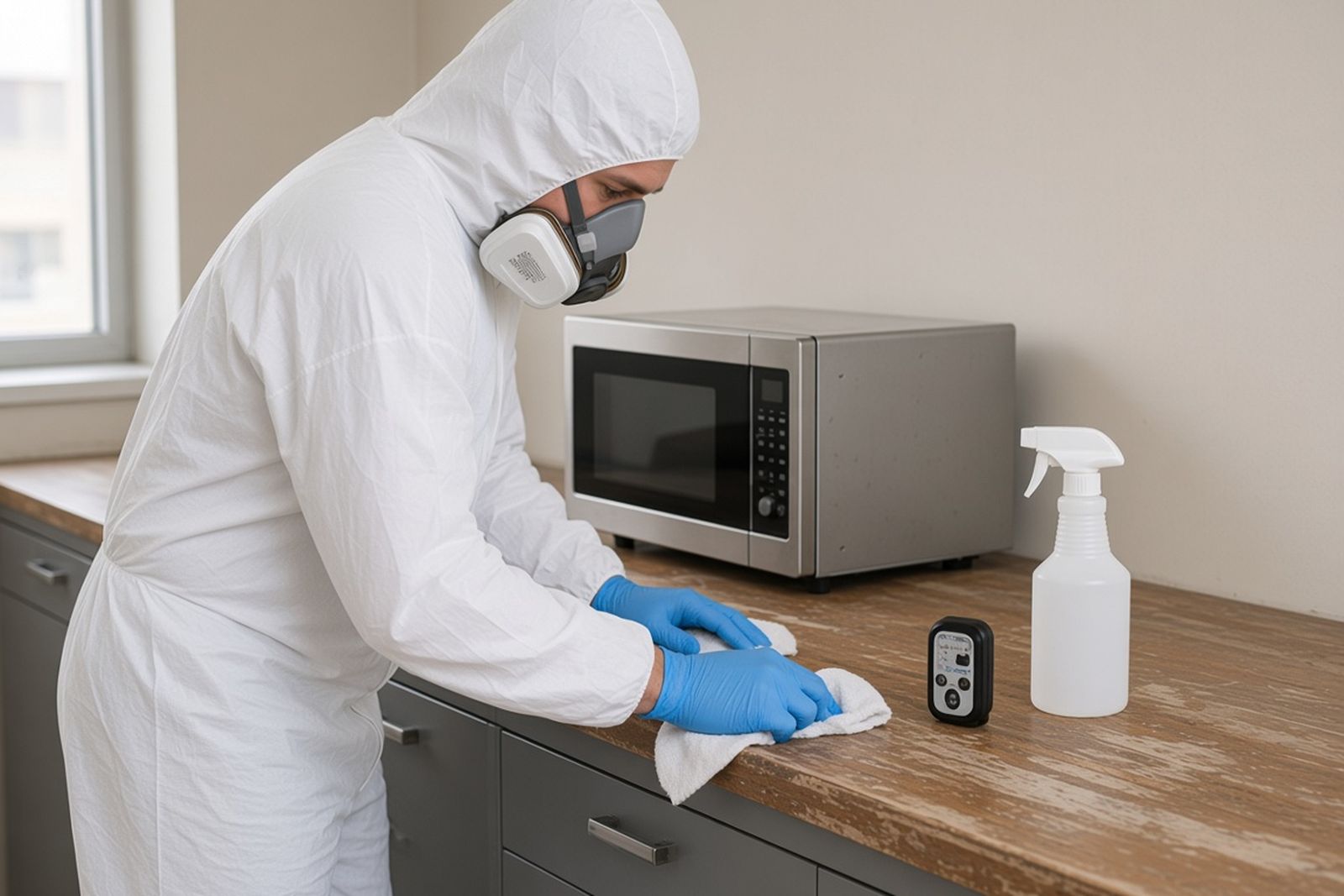
At the surface level, no. Blood on a tile floor behaves the same whether the tile is in a kitchen or a hotel lobby. A competent provider will remove visible soil, decide which porous materials must go, apply a disinfectant with an appropriate label claim for its full contact time and package regulated waste for proper disposal in either setting.
The differences sit around the process rather than inside it. Who owns the space, who is legally responsible for protecting the people in it, how quickly it needs to reopen and what records must be kept all shift when you move from a home to a workplace.
Understanding those differences helps you pick the right provider and set expectations. A company that excels at quiet, compassionate residential work may not be set up for a night shift in an operating retail store, and the reverse can also be true.
Extra duties an employer carries
When employees could reasonably be exposed to blood or other potentially infectious materials, federal workplace rules on bloodborne pathogens apply to the employer. Those rules set requirements around exposure control plans, protective equipment, vaccination offers, training and recordkeeping.
Recordkeeping is more demanding than many business owners expect, because exposure-related medical records and training records must be kept for set periods. Those duties apply to the employer's own staff, not to the outside remediation company, which carries its own obligations for its technicians.
In practice, this means a business should know in advance which incidents its own trained staff may handle and which require an outside provider. It also means that if an employee is exposed during an incident, the business needs a post-exposure process ready to go.
Homeowners do not carry these employer duties when they clean up after their own household. They do, however, carry the personal risk, which is one reason many choose not to handle anything beyond a very small spill.
Scheduling and access
Residential jobs usually revolve around the family's needs. Someone may need to retrieve medication, a pet may still be in the home or relatives may be traveling in. The provider works around those needs, often during the day, and the home can stay closed as long as the work requires.
Commercial jobs often revolve around operations. A store may want the work done overnight so it can open on time. A clinic may need one exam room back while the rest of the suite stays open. An office may have a lease that restricts after-hours access or elevator use.
Those constraints are real, but they should never compress the disinfectant's contact time or skip removal of contaminated materials. If a business asks a provider to rush, a good provider will explain what can be phased and what cannot. Partial reopening with clear barriers is often safer than a full reopening with shortcuts.
Who needs to be told in each setting
In a home, the circle is usually small: the owner or next of kin, perhaps a landlord, an insurer and sometimes law enforcement or a medical examiner who controls the scene first.
In a commercial setting, the list grows quickly. It can include the building owner and property manager, the tenant business, its insurer and the owner's insurer, a human resources lead, a safety officer, a union representative, security staff and sometimes a health department. Each may have a different question and a different deadline.
Assign one person to coordinate with the provider. That person approves the scope, fields questions from other stakeholders and receives the closeout records. Without a coordinator, providers can get conflicting instructions from different managers, which slows the job and muddies the paperwork.
Privacy deserves special attention at work. Coworkers may want to know what happened to a colleague, and customers may ask why an area is closed. Share only what people need to stay safe. Medical details about an employee are not something to post on a break room door, and a simple statement that an area is closed for professional cleaning is usually enough.
How materials and finishes change the scope
Homes tend to have carpet with pad, upholstered furniture, mattresses, wood floors and personal items with sentimental value. Many of those materials are porous and may need removal when fluid has soaked in. Decisions often involve belongings a family cares deeply about, so the conversation takes time.
Commercial spaces lean toward commercial carpet tile, sealed concrete, vinyl, stainless steel, laminate counters and modular furniture. Carpet tiles can often be removed and replaced individually, which can narrow the affected zone. Sealed and stainless surfaces are generally easier to clean and disinfect in place.
That said, commercial spaces bring their own hidden places. Raised floors, ceiling plenums, cubicle panel fabric, elevator cab seams and restroom partitions all deserve a look. Product compatibility matters as well. A 2024 study by Jennings and colleagues found that products above pH 8 accounted for 74% of failures in chemical resistance testing of plastics, a reminder to confirm that a disinfectant suits the surfaces in a clinic or office before it is used widely.
One incident, two settings: an illustration
To see the difference, follow one incident through two illustrative settings. In the first version, a person suffers a severe nosebleed and a fall in the hallway of their own home, leaving blood on hardwood, a runner rug and a wall. A relative calls a provider. The crew removes the rug, cleans and disinfects the sealed hardwood and wall, packages waste and walks the relative through the result. The paperwork is a scope, a product record, photographs and a disposal record.
In the second version, the same incident happens to an employee in the hallway of a busy dental office. The office manager closes the hallway, routes patients through a side door and makes sure the injured employee receives care. The provider must work after hours because the practice needs to see patients in the morning.
In the dental office version, the scope also addresses a stretch of carpet tile, a fabric-covered bench and a keypad by a door. The product is checked against the practice's existing surface compatibility list. The office manager receives the same records as the relative did, plus a note for the office's exposure log explaining that no staff member cleaned the area.
The science in both versions is identical. The coordination, the timeline and the records are not.
Home vs business insurance claims
Homeowners typically deal with a single personal lines policy, and the question is often whether the event falls within coverage and which part of the policy responds. Commercial claims may involve a property policy, a general liability policy, workers' compensation for injured staff and a landlord's policy for building elements.
Coverage outcomes are specific to the policy and the event. No provider can promise what an insurer will pay. In either setting, notify the carrier early, share the provider's written scope and keep receipts, photographs and waste documentation together.
Before work begins, ask your insurer, and any health agency that licenses or inspects your business, what documentation they expect to see.
What should you ask a provider in each setting?
Some questions apply everywhere, and some become more important in one setting than the other. Use this short list as a starting point.
- For any job: Which disinfectant will you use, what is its EPA registration number and what contact time does the label require?
- For any job: What will you remove, what will you clean in place and what is your reason for each decision?
- For residential jobs: How will you handle personal items and photographs, and can a family member be absent while you work?
- For residential jobs: Can you coordinate directly with a landlord or insurer so the family does not have to?
- For commercial jobs: Can you work after hours, phase the work and set up barriers that allow partial reopening?
- For commercial jobs: What documentation will you provide that fits our safety program and our insurer's requirements?
How do you decide which kind of provider fits your situation?
Many decontamination companies handle both residential and commercial work. What matters is whether they have done work similar to yours. A provider who routinely services clinics will already know how to navigate after-hours access and compatibility lists. A provider known for residential work will already know how to move gently through a home full of memories.
Ask for examples of comparable jobs, without identifying details, and for a sample closeout package. Those two things will tell you a great deal about whether the provider can meet your setting's particular demands.
Whichever setting you are in, pay attention to how the provider treats you on the first call. Clear answers, no pressure and a willingness to put the plan in writing are good signs whether you are a grieving relative or a facilities director with a deadline.