Short answer
Sometimes. A homeowners policy may respond to biohazard decontamination when the contamination flows from a covered cause, such as a sudden accident or a covered water event, and it often will not when the cause is excluded or gradual. Your carrier decides, not the cleanup company. Report promptly, document before work begins, and ask for the coverage position in writing.
Cause first: how a policy sees biohazard decontamination
Most homeowners policies do not list biohazard decontamination as its own line of coverage. Instead, the insurer looks at what caused the contamination and asks whether that cause is a covered peril under your policy form.
That framing matters because biohazard decontamination spans very different events. A blood spill after a fall at home, a Category 3 sewage backup into a finished basement, and a room left contaminated after a prolonged illness can all need the same careful disinfection, yet each one reaches the policy through a different door.
When you call your carrier, describe the event that produced the contamination first and the cleanup second. The adjuster needs the cause to find the right coverage part.
It also helps to know which parts of your policy might be in play. Dwelling coverage concerns the structure itself, such as drywall, flooring and built-in cabinets. Personal property coverage concerns your belongings, such as a mattress or an area rug. Some policies also include additional coverages for debris removal or reasonable repairs made to prevent further damage. A single biohazard event can touch all of these, each with its own limits and conditions.
Carriers tend to evaluate sudden, accidental events more favorably than slow, ongoing ones. The exact result still depends on your form, endorsements, exclusions and limits, so treat the examples below as prompts for your conversation with the adjuster rather than predictions.
- A sudden injury or medical emergency that leaves blood or other potentially infectious materials on flooring, walls or furnishings.
- A sewage or drain backup, which many policies handle only through a separate water backup endorsement.
- Contamination that follows a covered event, such as a burst pipe that carries soiled water across the floor.
- Contamination found after a long, unnoticed condition, which carriers often review under wear, neglect or gradual damage language.
- Illness-related disinfection with no physical damage, which may not fit property coverage at all.
Porous materials and a strong claim file
Hard, nonporous surfaces can usually be cleaned and then disinfected in place. Carpet pad, drywall, upholstered furniture and subfloor that absorbed fluid are a different story, because disinfectant cannot reliably reach everything soaked into them.
When those materials have to be removed, the claim shifts from cleaning into property damage and replacement. That is often the largest part of the file, and it is where the adjuster wants the clearest evidence.
Ask your provider to explain, in writing, why each removed item could not be decontaminated in place. A note that says the carpet pad was saturated beyond the reach of a labeled disinfectant carries more weight than a note that just says it was discarded.
Photographs of the underside of removed materials help too. A picture showing that fluid wicked through carpet into the pad, or up the back of a baseboard, explains the removal decision better than any written summary. If the provider cuts a test section before removing a larger area, ask them to photograph that step as well.
Adjusters make decisions from records. The better your file, the easier it is for them to connect each charge to the event.
Before anything is moved, take wide photographs of each affected room, then closer ones showing how far the contamination spread. Keep these private and respectful; they are for the claim, not for sharing.
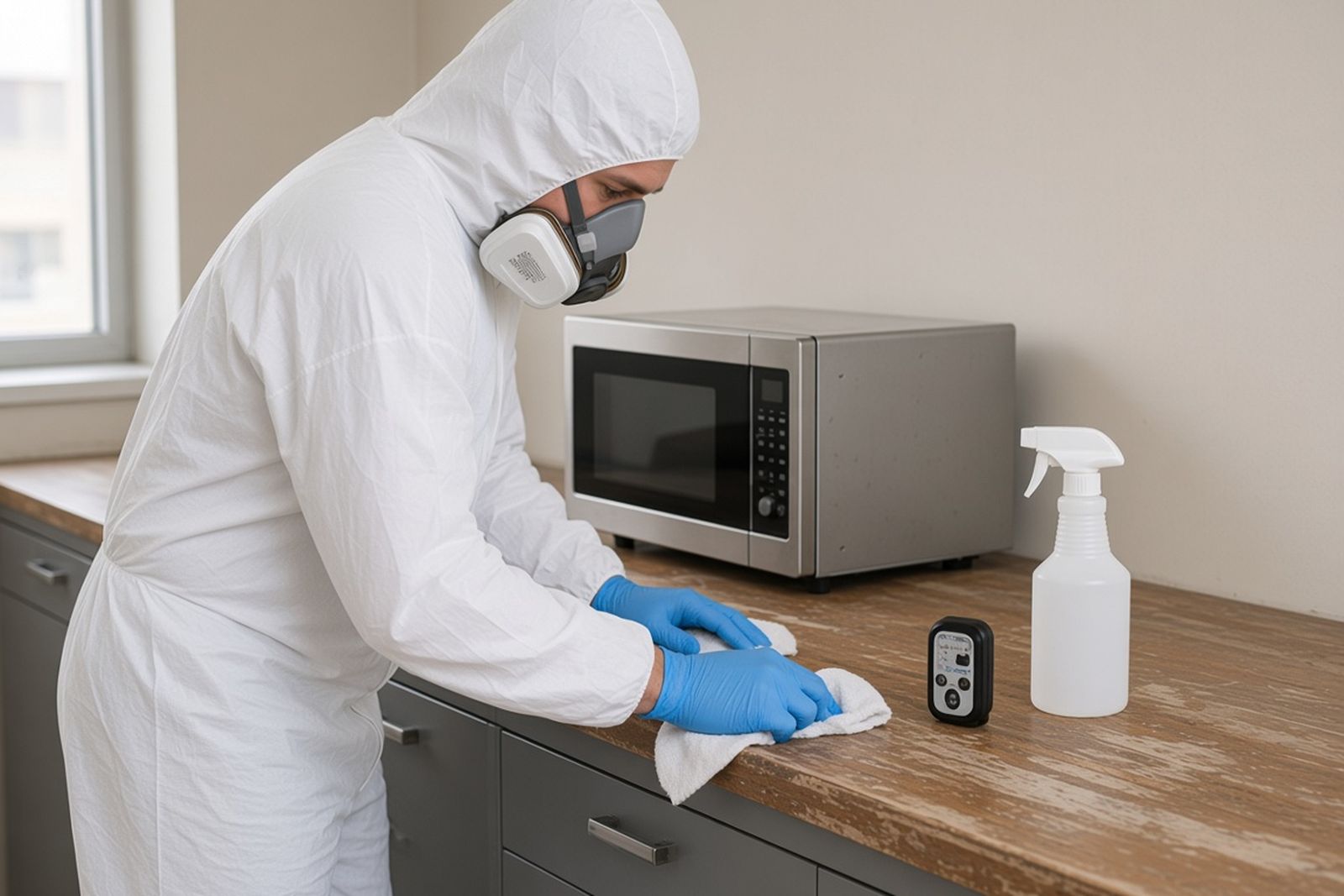
Once the work starts, the provider should add their own documentation. Useful items include the disinfectant product names and their EPA registration numbers, the contact time each label required, a list of removed materials with room locations, and the waste manifests or receipts showing how regulated waste left the property.
What if the biohazard happened in a rental or shared building?
Ownership of the damaged materials often decides whose policy responds. A landlord's policy generally concerns the structure, while a renters policy concerns the tenant's belongings and possibly liability.
In a condo, the association's master policy and your unit-owner policy may split responsibility between common elements and the interior. A leak that carries contaminated water from one unit into another can involve two or three carriers at once.
When several carriers are involved, one shared set of records saves time. Ask the provider to prepare a single report that divides the work by space and by owner, so each adjuster can find the portion that applies to their insured without asking for a separate inspection.
Before signing a work authorization, confirm who has the authority to hire the provider for each space. Read the lease or the association's governing documents so no one is billed twice.
Worked example: a basement drain backup
The following case is made up to illustrate the process. A homeowner comes downstairs to find that the floor drain in a finished basement has backed up overnight, spreading sewage across carpet, into the base of drywall and under a storage shelf of boxed holiday decorations.
The homeowner keeps family and pets upstairs, photographs the room from the doorway and calls the insurer before calling anyone else. The claim representative asks whether the policy includes a water backup endorsement, which it does, with its own sublimit.
A decontamination provider documents moisture readings, removes saturated carpet, pad and the lower section of drywall, cleans and disinfects the concrete and framing, and packages the waste. Their report lists every product and every removed material by location.
In this made-up case, the adjuster reviews the backup endorsement, applies the sublimit and asks separate questions about the boxed decorations under contents coverage. Nothing about this outcome is guaranteed for a real claim; it shows how the cause, the endorsement and the documentation drive the review.
Should the cleanup company talk to my insurer for me?
Many providers will send documentation directly to the carrier and answer the adjuster's technical questions. That help is valuable, especially when you are stressed or grieving.
What a provider cannot do is decide coverage. Be cautious with anyone who promises that insurance will pay, asks you to sign away claim rights you do not understand, or pressures you to authorize work before you have heard from the carrier.
A reasonable middle path is to authorize only emergency steps that limit further damage, such as extraction and containment, while the adjuster reviews the rest. Ask your carrier whether that approach fits your policy's mitigation duties.
Read any assignment of benefits or direction-to-pay form slowly before you sign it. These documents can change who receives the insurance payment and who can negotiate with the carrier. Some homeowners are comfortable with that arrangement; others prefer to keep control. Either choice is reasonable as long as you understand it, and you can ask the carrier to explain how it treats such forms.
What should I do today if contamination has already happened?
Start with safety. Keep children, pets and anyone with a weakened immune system out of the area, and avoid touching fluids or soiled materials without proper protection.
Then take these steps in roughly this order.
- Photograph the scene from a safe distance before anything is moved.
- Notify your carrier and write down the claim number, the adjuster's name and the date.
- Ask the carrier which coverage part it is reviewing and what documentation it needs.
- Request a written scope from a decontamination provider that separates cleaning, removal, disinfection and waste handling.
- Keep every invoice, receipt and product list in one folder.
- If the carrier denies part of the claim, ask for the reason in writing and the policy language it relies on.
The part you control
Biohazard decontamination is rarely a simple yes or no for insurance purposes. The cause of the contamination, your policy form and endorsements, and the quality of the records all matter.
You can control the last of those. Report quickly, photograph carefully, insist on a detailed written scope, and keep the adjuster informed. If the situation also involves a death or a mental health crisis in your household, you can reach the 988 Suicide and Crisis Lifeline by calling or texting 988 at any hour.